01 Jul QSR Sports Sponsorships: What’s Working Right Now
Sports sponsorships have become one of the most strategically important investments a quick-service restaurant brand can make, and the data can prove it.
Traditional growth levers are under pressure. TV ad costs are rising. Digital CPMs keep climbing. Delivery app dependency has weakened brand loyalty. In a category where differentiation is hard to sustain on price or convenience alone, the brands that are winning are the ones building emotional connection, not just awareness.
Sports is one of the few environments left where brands get all of it at once: a captive, emotionally engaged audience, built-in routine, community identity, and a natural overlap with food culture. These aren’t manufactured marketing moments: they’re already happening across social media, broadcast, and live events. The question is whether your brand is part of them.
Here’s what the data says is working, and why it works.
Pro Sports: Social Activations That Drive Real Brand Value
Social media is one of the highest-reach environments in digital media. Professional team accounts command massive followings, game-day content routinely outperforms most brand content, and the fan communities are deeply engaged. For QSR brands, the opportunity isn’t just visibility, it’s proximity to moments fans already care about.
Here are four activation types generating measurable brand exposure value across the major leagues.
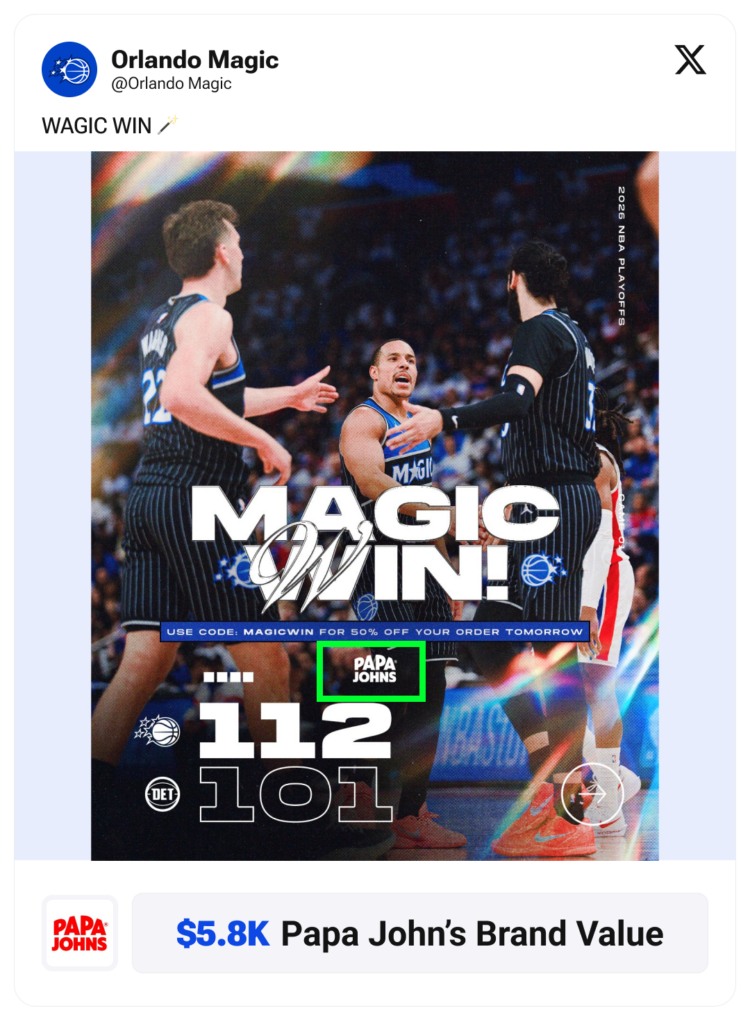
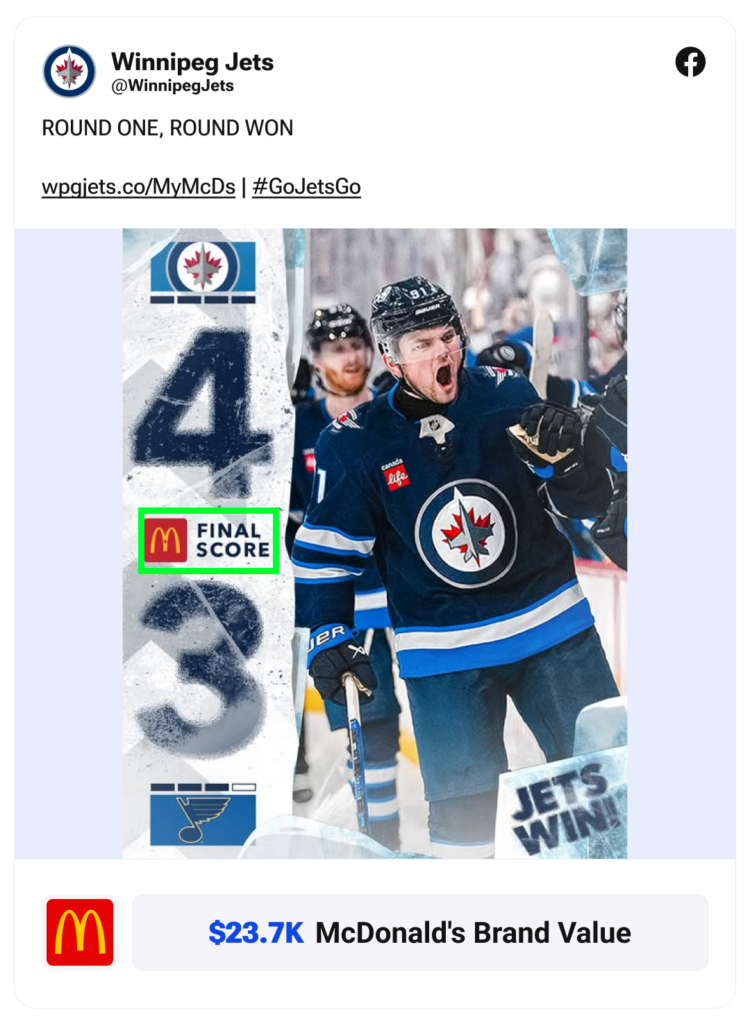
One of the highest-performing structures in QSR sports sponsorships is the conditional offer, a promotion that activates when the team wins or achieves a specific statistical milestone. It works because it’s not just a discount; it’s a shared celebration. The players perform, the team wins, the fan is naturally happy, then the partner brand shows up to make the moment even better with a discounted or free item.
The Orlando Magic and Papa John’s do this well. When the Magic win, the celebratory social media graphic includes a promo code for 50% off their next order. That single mechanic does a lot of work simultaneously: it rides the emotional high of a win, which already drives some of the strongest engagement and organic amplification of any content a team posts. The promo code then extends the reach further, driving redemptions and incremental sales that a standard brand impression never could. A single post generated $5,811 in brand exposure value, and over a full season across multiple social platforms, that partnership produced $152,000 in total brand value while driving a surge of orders.
What makes this activation model especially powerful is who it reaches. Win-based offers don’t just engage the team’s existing fanbase, they attract deal seekers and casual fans who might not otherwise interact with the brand. That’s new customer acquisition baked into a sponsorship asset. The perfect partnership creates value for the team, the fan, and the brand all at once. This one does exactly that.
At its core, every QSR sponsorship is about getting people to visit the restaurant and place an order. Location-driven activations connect the rhythm of the sports calendar to the brand’s actual business goal: foot traffic.
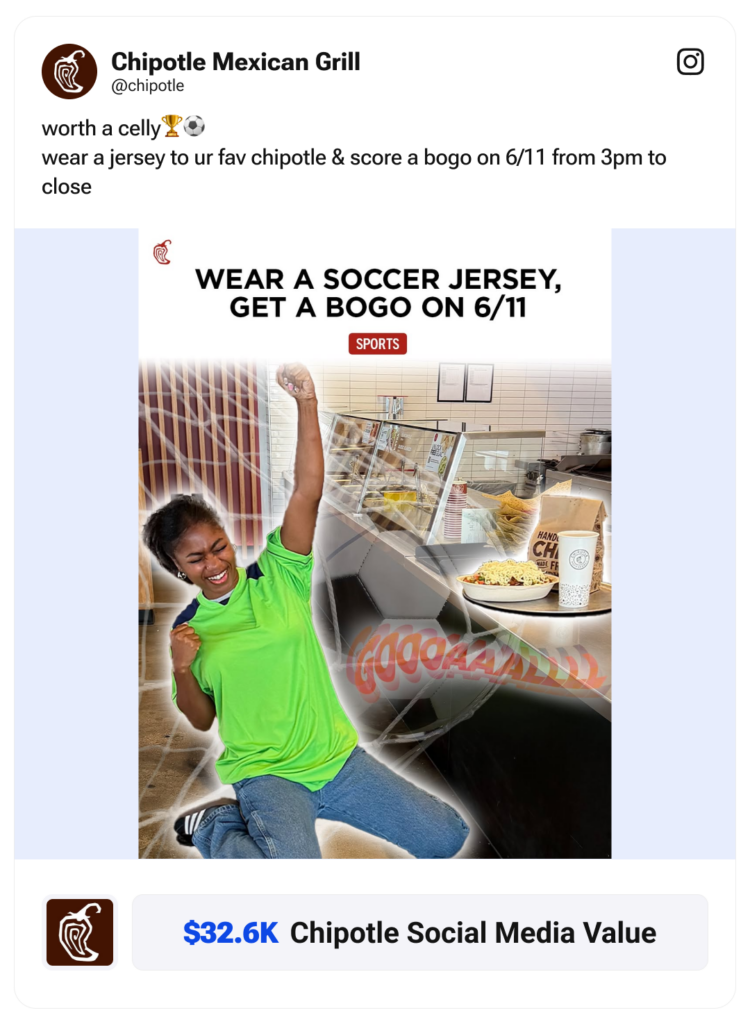
Chipotle has turned this into a repeatable playbook. During the 2026 FIFA World Cup, the brand ran a simple but effective mechanic: wear any soccer jersey to your nearest Chipotle on June 11 from 3pm to close and get a BOGO. No app, no promo code, just show up in your kit. That one Instagram post generated $32,600 in Social Media Value from Chipotle’s own account. The mechanic works because it does two things simultaneously: it rewards fans who are already emotionally invested in a sporting moment, and it gives them a reason to walk through the door that same day.
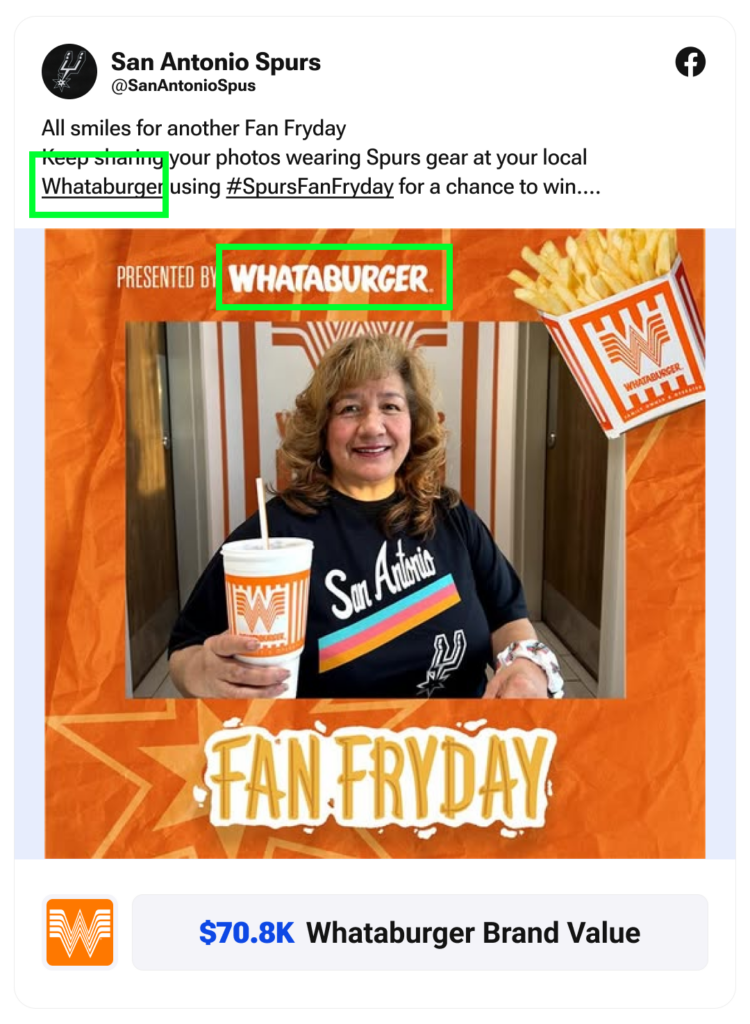
The ceiling for this activation type, when the brand and market are perfectly aligned, is significantly higher. Whataburger’s “Fan Fryday” series with the San Antonio Spurs, where fans share photos wearing Spurs gear at their local Whataburger for a chance to win, generated $70,837 in Brand Exposure Value from a single Facebook post. That’s an outlier, but it illustrates what happens when a regional brand, a deeply loyal fanbase, and a recurring series mechanic all come together in the same market.
The most valuable asset for corporate partners on sports social media isn’t always splashy campaign, it’s a consistently visible digital on content that is proven to engage. Tying your brand name to a content series throughout the season builds awareness at a frequency that standalone campaigns can’t match, and it works even when the team isn’t playing.
Some of the most effective formats: final score graphics, starting lineups, player news, and birthday posts. These are pieces of content fans actively seek out and engage with heavily, which means your brand is showing up in high-intent moments, not just filling ad inventory.
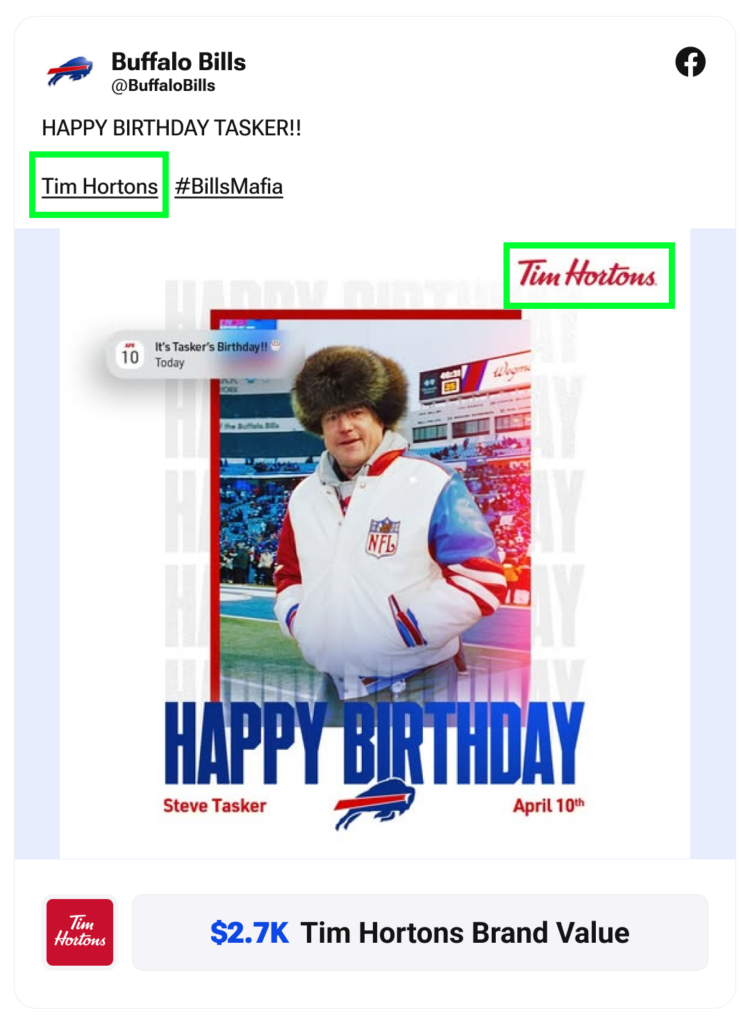
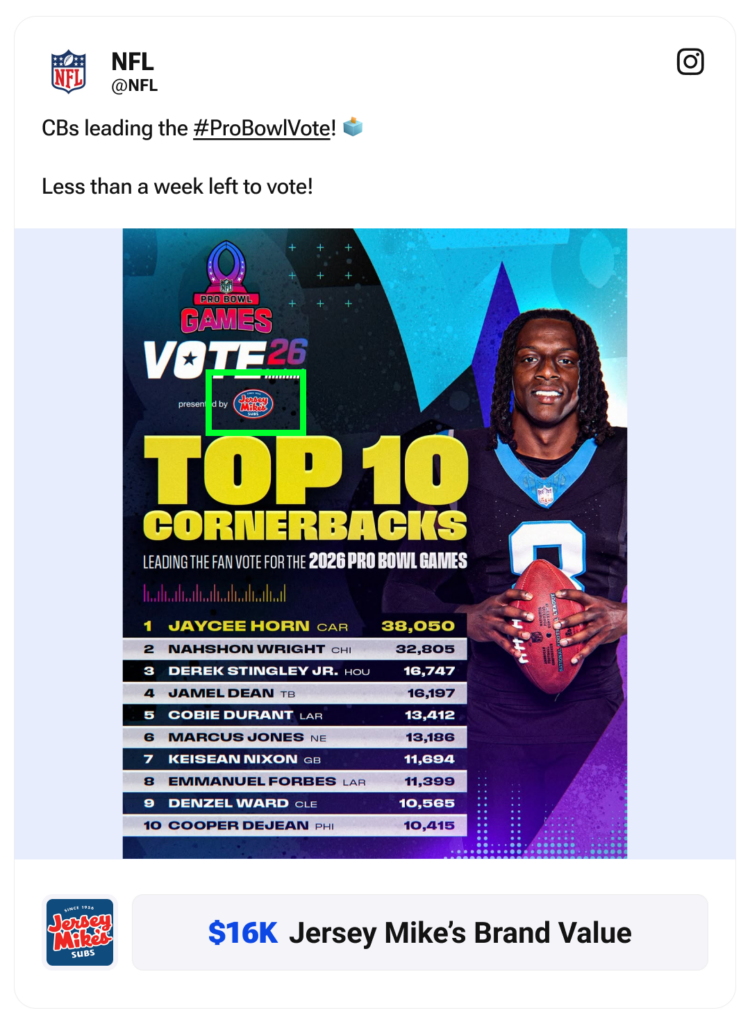
Jersey Mike’s executes this at the league level, appearing as a presenting sponsor on NFL Pro Bowl Vote graphics posted to the @NFL Instagram account, generating $16,072 in Brand Exposure Value from a single post. Tim Hortons takes a similar approach with the Buffalo Bills, appearing on a Steve Tasker birthday post that generated $2,700 in Brand Exposure Value on Facebook, a piece of content that has nothing to do with a game result but everything to do with fan affinity.
The brands that win with this asset aren’t the ones who show up once. They’re the ones fans start to associate with a specific moment in the team’s content calendar, the score graphic, the birthday, the lineup card. That association builds over a full season in a way that’s difficult to replicate with any other sponsorship asset.
Some of the most effective QSR sponsorship assets aren’t built around campaigns — they’re built around moments that happen naturally inside the game.
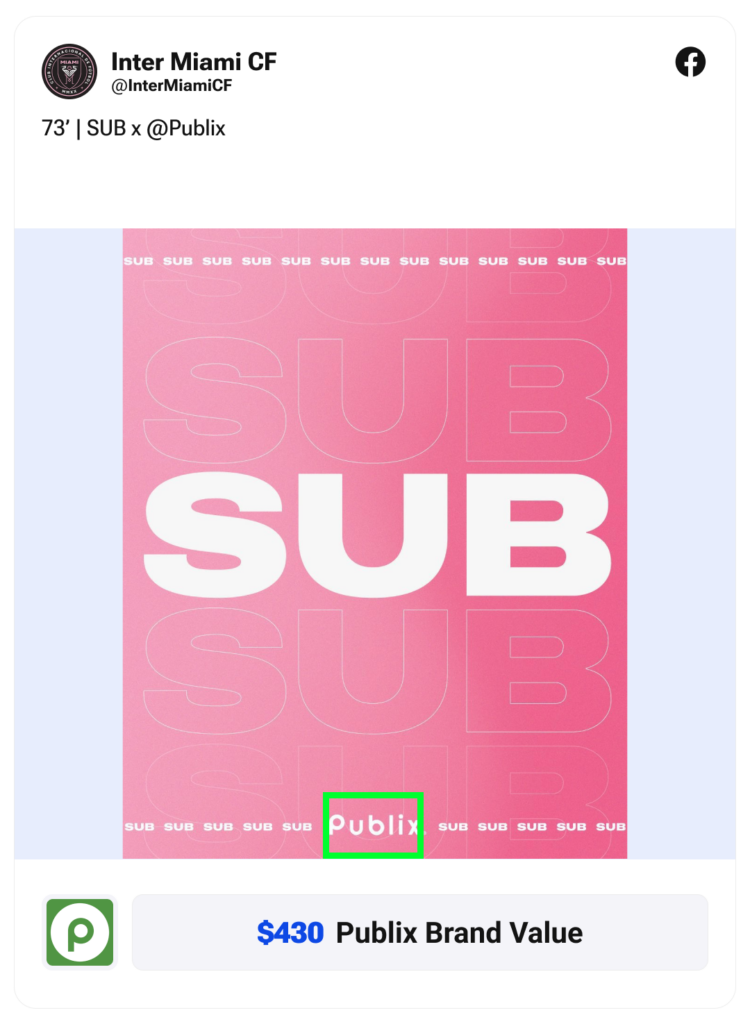
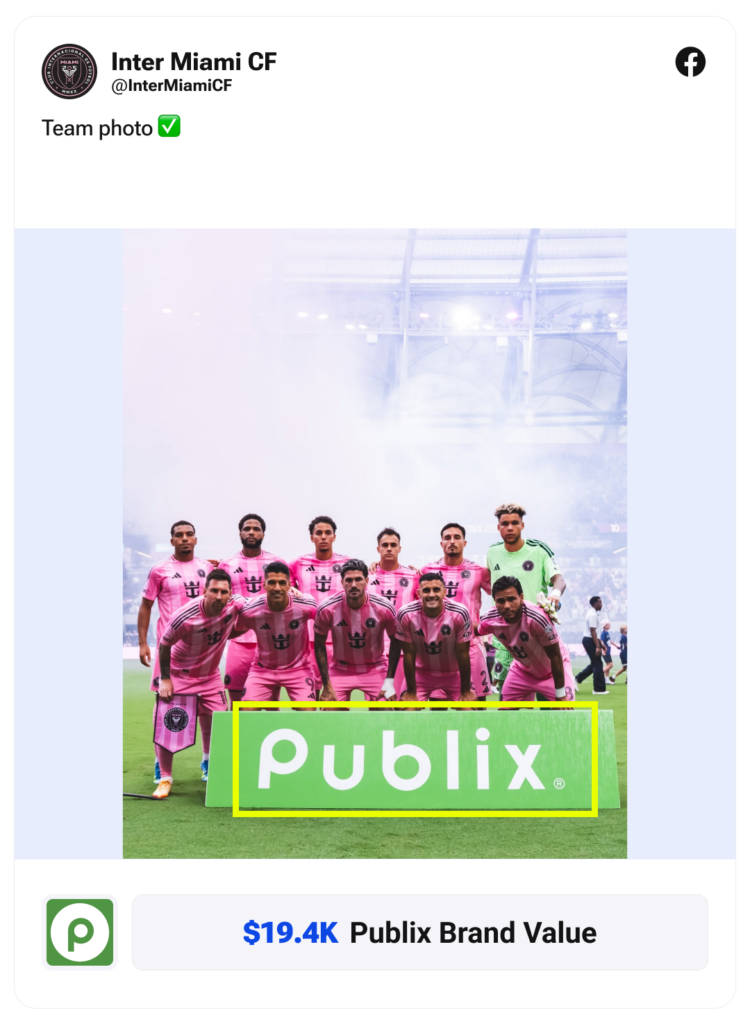
Inter Miami CF does this twice in the same partnership. On match days, the club posts a team photo before kickoff — full squad, pink kits, and a large Publix sign front and center. The May 17 version generated $19,445 in Brand Exposure Value on Facebook, with 854,481 impressions and 19,065 engagements.
Then there’s the SUB mechanic. Every time Inter Miami makes a substitution, the club fires a real-time post on X: “SUB x Publix” — a bold graphic where the word SUB fills the frame, Publix logo at the bottom. Multiple times per game, every game, all season. The individual post BEV is modest, but that’s not the point. Publix. Subs. Every game. All season. For a brand with a strong deli and sub counter, that’s not a logo placement, that’s brand positioning hiding inside a live game update.
College Sports: Big Reach, Brand-Friendly Audiences
Quick-service restaurants have a long history of tying their names to college athletics — and for good reason. The college sports fan is one of the most valuable audiences a QSR brand can target. Students looking for affordable, fast food. Alumni traveling to and from games. Watch parties in college towns that turn a Saturday afternoon into an all-day occasion. The behavioral overlap between QSR customers and college sports fans is as strong as it gets.
The activation options span every tier of investment: event entitlements, in-stadium signage, broadcast integrations, and digital content — giving brands consistent visibility across the full fan journey, from the drive to campus to the postgame meal.
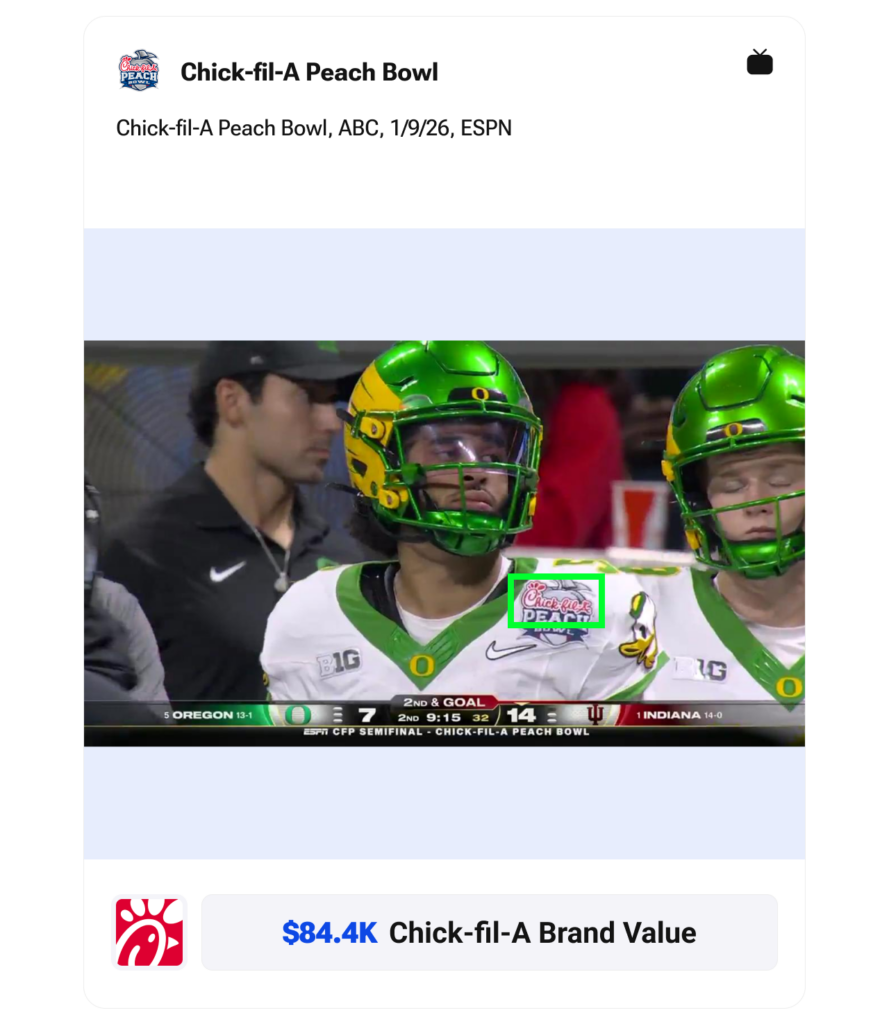
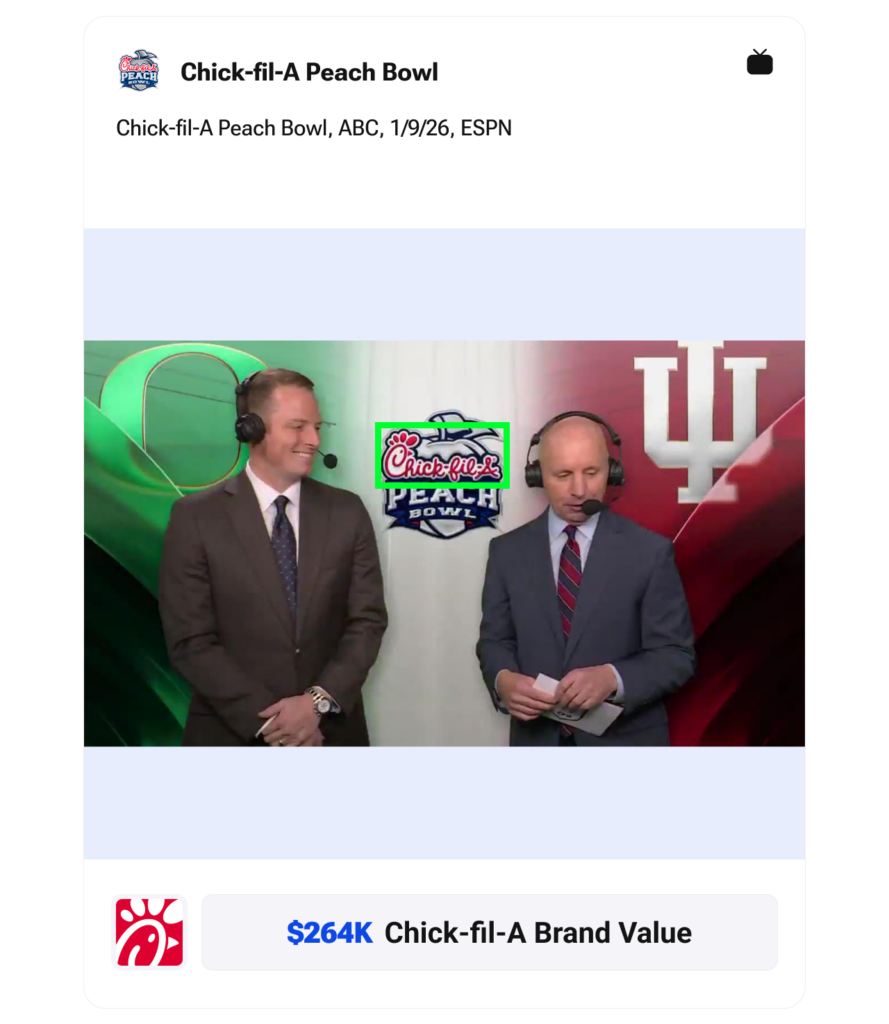
At the top of that hierarchy sits the bowl game entitlement — and no example makes the case better than the Chick-fil-A Peach Bowl. Broadcast on ABC and ESPN on January 9, 2026, the game generated $15.7 million in total Brand Exposure Value for Chick-fil-A — making it the single most valuable QSR activation in sports sponsorships. The brand appeared in nearly every camera angle throughout the broadcast: on-field signage, anchor desk backdrops, player uniforms, and chyrons. A single pre-game anchor desk frame generated $264,000 in Brand Exposure Value. A sideline shot of Oregon players with the Peach Bowl logo visible on their uniforms generated $84,000. That’s the ceiling of what a college sports entitlement can deliver — and one that very few other sponsorship categories can match.
High School Sports: The Underrated QSR Sponsorship Opportunity
High school sports sponsorships rarely get the attention they deserve in brand strategy conversations — but for QSR brands with strong regional presence, they may offer the best return on investment of any tier.
The audience profile is almost perfectly aligned: students looking for affordable, fast, accessible food before and after games; parents and families making quick decisions about where to eat around busy game-night schedules; and communities where a brand’s local presence creates genuine goodwill rather than just visibility. For regional chains especially, high school activations amplify what the brand already stands for — the community pride that fuels high school sports fandom extends directly to the businesses that show up and support it.
There’s also a catering angle that’s easy to overlook. High school athletics programs run year-round — jamborees, tournaments, banquets, travel days. QSR brands that build relationships at this level aren’t just buying logo placements, they’re becoming the default food choice for entire programs and the families around them.
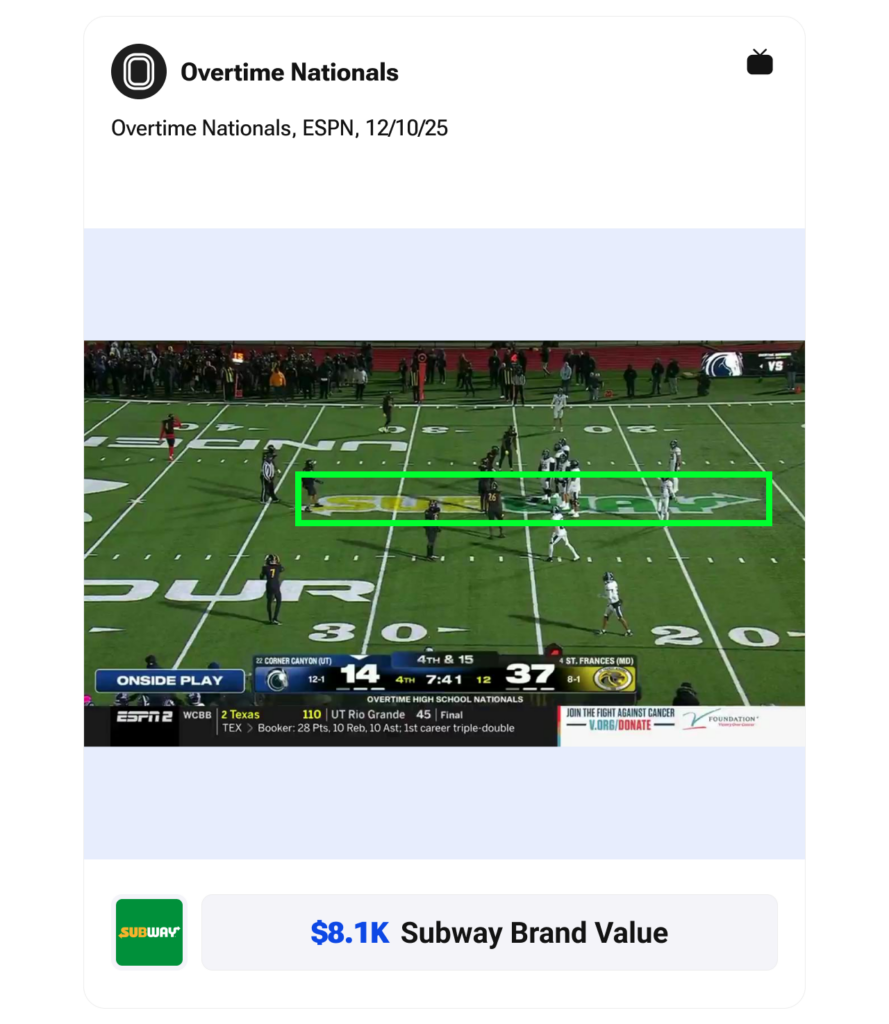
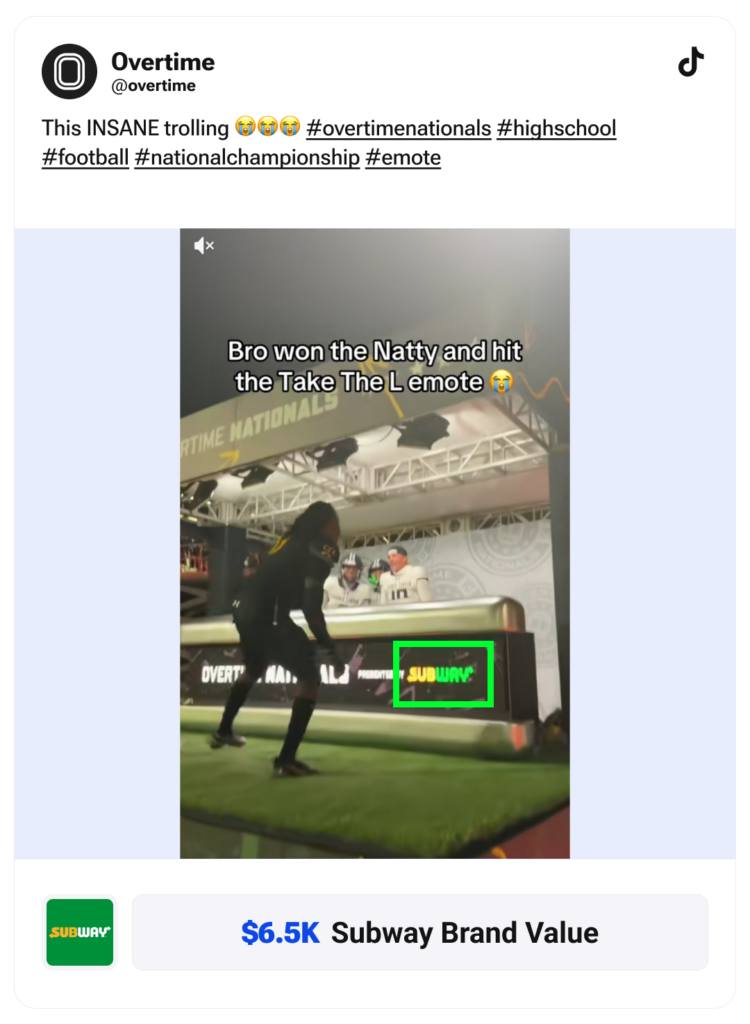
When those games make it to broadcast, the exposure potential expands significantly. Subway’s sponsorship of the Overtime Nationals generated $373,436 in total Brand Exposure Value on ESPN2 on December 10, 2025 — with the Subway logo visible on-field, on signage, and in highlight clips that extended to TikTok, where a single video generated an additional $6,500 in brand value.
The Missing Piece: Knowing What Your Sponsorship Is Actually Worth
QSR brands invest in sports sponsorships for a reason — but too many still can’t answer the most basic question their CFO will ask: what did we actually get for that?
Brand Exposure Value (BEV) is the metric that changes that conversation. Rather than relying on impressions estimates or reach projections that vary wildly depending on the source, BEV quantifies the value of every moment your logo, product, or brand name appears in content — on social media, in broadcast, in highlights, and beyond.
Every data point in this post was measured by Zoomph. Our AI-powered sponsorship measurement platform tracks brand exposure across social and broadcast in real time, so QSR brands and their sports partners can see exactly which activations are driving value, optimize mid-season, and walk into renewal conversations with evidence instead of estimates.
That’s the difference between a sponsorship that renews because the relationship is good and one that renews because the numbers are undeniable.
Ready to Measure the Value of Your QSR Sports Sponsorships?
Whether you’re a QSR brand evaluating your current portfolio or a sports property making the case to a quick-service partner, Zoomph gives you the data to prove — and improve — performance across every channel.
See how the brands and teams in this post are measuring their results — and find out what your sponsorship is really worth. Request a Demo here.