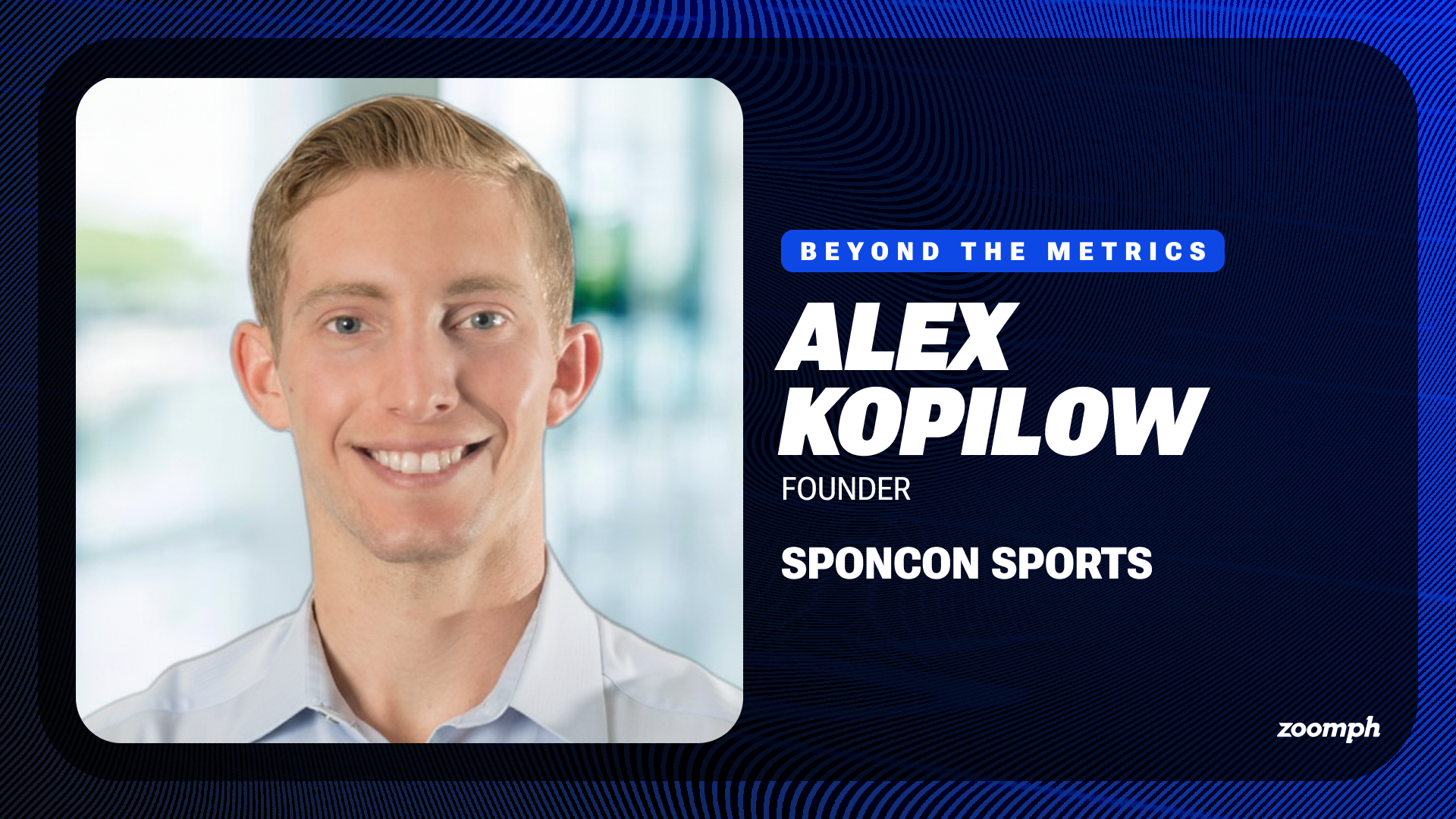
23 Feb Beyond The Metrics: Alex Kopilow, Founder, Sponcon Sports
At Zoomph, we champion the power of partnerships, marketing, business intelligence, and social media. Our Q&A series puts the spotlight on industry leaders, giving you an inside look at their expertise, strategies, and perspectives – beyond the numbers. Join us as we uncover valuable insights straight from the minds shaping the industry.
Tell us a bit more about your background
I grew up on Long Island and went to Ohio State, where I studied journalism. After college, I became a local sports anchor and worked in markets across the country, from Sioux Falls, SD, and Lawton, O,K to upstate New York and Knoxville, TN.
At 27, I pivoted to agency work, starting as an intern. That stretch became my unofficial master’s in digital marketing, where I focused on organic and paid social, creator marketing, and a full 360 strategy for brands like McDonald’s, Walmart, Cardinal Health, and Ulta Beauty.
I broke into the team side in 2021 as the Chicago White Sox’s first Digital Partnerships Manager, and that’s where everything clicked. I got to stay in content without being on 24/7, and got to work in partnerships without needing to hunt for and entertain clients. Plus, I love that my job is measurable and impacts the bottom line.
Since then, I’ve had stops at Madison Square Garden, Sports Illustrated (via The Arena Group), and the New York Mets. Today, I’m the founder of Sponcon Sports, a digital consultancy and newsletter (launched 10/2023) that is read by nearly 4,000 sports marketing professionals worldwide.
Tell us about your current role! We love to hear about your goals, focuses, and responsibilities:
I work directly with professional teams, leagues, and brands to uncover undervalued digital inventory and install the systems, workflows, and valuation frameworks that turn digital into a consistent, scalable revenue engine.
There’s a long-standing belief in sports that sponsored content doesn’t work. My view is simple: the issue isn’t sponsorship, it’s execution. Sponsored content should be held to the same creative standard as everything else in the ecosystem. I help organizations drive revenue across their entire digital footprint — organic and paid social, email, web, app, SMS — by building partner integrations fans actually want to engage with.
Share a professional accomplishment that you are extremely proud of, or share a campaign, organizational success, or win that you are proud of:
One accomplishment I’m especially proud of came during my time with the New York Mets, where our mandate extended beyond traditional sponsorship sales.
We set out to prove that sports inventory could attract media buyers, not just brand partnership teams. That required a lot of market education, as many media buyers weren’t used to thinking of teams as scalable digital media platforms.
What ultimately moved the needle was the data. We led with audience insights, reach, and engagement generated in-venue, on TV, and across owned and earned digital channels. It showed how teams could deliver scale comparable to other media channels.
It didn’t replace the traditional long-term sponsorship model, but it created a complementary revenue stream. Media buyers tend to transact in flighted deals, which adds flexibility and incremental spend when the infrastructure is in place. Proving that out, and helping open a new category of demand for team-side inventory, is something I’m really proud of and think more organizations should explore. There’s also a big opportunity to grow existing business by engaging the media buying teams of current partners.
What is your favorite part about working in the sports industry?
Sports have always been a personal passion of mine, so getting to build a career around them makes the work more meaningful.
But the simplest way I explain it is this: in most industries, if you’re working late, it’s usually because something went wrong. In sports, if you’re working late, there’s a good chance it’s because something exciting is happening. There’s an energy around live moments, big games, and cultural relevance that’s hard to replicate anywhere else. Being part of that is what makes it special.
What is a trend you are keeping an eye on in the sports industry?
Episodic social shows have become one of the most effective formats over the last year. Instead of one-off posts, brands are building recurring, personality-driven series that give audiences a reason to come back. Visa is a great example. Through its VCARB and 49ers partnerships, it built mockumentary-style social shows that generated millions of views and proved the format can scale across properties.
We’re also seeing publishers like House of Highlights launch standalone show accounts, such as Clash, built entirely around repeatable debate formats. They tested the format, validated it, and then expanded.
For teams and leagues, the opportunity is worth testing. These formats are replicable, creator-friendly, and highly monetizable. When you treat digital like programming instead of posts, you create inventory that compounds over time. That shift from selling moments to building franchises is where I think the industry could be headed.
What advice would you share with young professionals who want to work in the sports industry?
The sports industry is extremely competitive. You can’t control when you get in, but you can control how prepared you are when the opportunity comes. Start by figuring out what you actually want to do, and remember, you don’t need to work for a team to build those skills. There are leagues, agencies, brands, tech companies, hospitality groups — plenty of paths into the business.
Networking matters, but it has to be done thoughtfully. Reach out on LinkedIn when you don’t need anything, and ask something specific about someone’s role or experience. Skip vague asks like “Can I pick your brain?” People are generous with their time when they see you’ve done your homework.
Also, don’t underestimate LinkedIn commenting. Thoughtful comments on posts can get as much visibility as publishing your own content. Once people see your name regularly, your cold outreach becomes much warmer. Just skip “totally agree” and aim to add value, even if it’s just a sharp question.
What is your favorite product feature or specific use case of Zoomph that you’ve used at previous stops in your career?
One feature I see underused in Zoomph is tracking open inventory, not just active sponsored campaigns. Tagging unsold content gives you the data to measure reach, engagement, and viewership before a brand even buys it. That data is critical for setting value and pricing, and for convincing a partner why they should invest.
Too often, organizations rely on a “built-if-sold” model, only creating content once a brand commits. The problem is, untested content is a harder sell unless your reputation is ironclad. A better approach is “built-to-sell”: test it first, measure it, then present it with confidence. It turns digital inventory into a predictable, monetizable asset.
Do you have a favorite experience or memory from your time working in the sports industry?
One of my favorite memories comes from my first season with the White Sox. Game three of the playoffs was the first time fans were in the stands for a playoff game since 2008, and the atmosphere against the Astros was electric. The team came back to win and it was easily one of the best games I’ve ever attended.
On top of that, we captured sponsored mic’d-up content from a player on the bench — approvals were tricky (but the organization was bought in!), and it was only for the first half — but it perfectly captured the moment when the team overcame a deficit to take the lead. That content performed incredibly well across channels and set the tone for a season-long partnership the next year. It was one of those moments where the energy, the fan experience, and the business impact all aligned.
Outside of the region you currently live in, what is one city or region you think everyone should visit at least once, and why?
Portugal! Especially if you’re on the East Coast, is slightly longer than a cross-country flight. Lisbon was my favorite city. Three must-hit spots for food: Manteigaria (for Pastel de nata), Ramiro (for seafood), and Frangasuiera (for Piri Piri chicken).
Do you have any hobbies that you’d like to share?
I love to cook and bake. Alison Roman’s recipes are my go-to for most occasions. Just search Alison Roman + The Stew or Alison Roman + The Cookies and you’re all set.
Is there a brand that deserves a shout-out? Let us know who they are and what they are doing well!
I’ve been a big fan of what Cerave has been doing over the last year in sports, whether it was the Heads of Cerave campaign with Anthony Davis, Paige Bueckers, and Adrian Wojnarowski, their NBA partnership, or their recent activation with Kevin Durant. What they get right is how they engage with basketball fans everywhere they spend their time (as a fan), going beyond teams and leagues and partnering with media members and fan/parody accounts.
Did you participate in any sports in high school or college? If so, what are they – are there any facts or accomplishments you want to include?
I was on the baseball team and bowling team in high school (yes, there was a bowling team, haha). My high score is 279, but I haven’t bowled competitively or in a league since I left for college.