09 Apr Healthcare Sports Sponsorship: What’s Working Right Now
Healthcare sports sponsorship is one of the fastest-growing categories in professional sports partnerships – and one of the least understood.
Health systems, hospitals, pharmaceutical companies, pharmacy chains, and regional medical brands are quietly becoming some of the most active sponsors across the NBA, WNBA, MLS, NWSL, and MLB. But unlike consumer brands that have decades of sports marketing playbooks to draw from, most healthcare organizations are still figuring out where to invest, what actually works, and how to prove it’s working at all.
Zoomph is helping to change that.
Using real sponsorship data from Zoomph’s measurement platform — which tracks everything from logo visibility and content performance across social media and broadcast to calculate what each brand impression is actually worth — we’re breaking down four high-value activation types for healthcare brands, with real dollar figures from real partnerships.
Whether you’re a sponsorship professional evaluating where your next dollar should go, a healthcare marketer trying to build a business case internally, or a brand that already is investing in sports sponsorships, this post is designed to help provide valuable perspective.
Healthcare marketing faces structural challenges that most other categories don’t. Privacy regulations limit digital targeting. Ad platform restrictions constrain healthcare-specific messaging. And the nature of healthcare decision-making — slow, trust-driven, household-level — makes high-frequency performance advertising a poor fit.
Sports sponsorships can help avoid most of these challanges. Here’s why the fit is so strong:
- Community trust: Hospitals and health brands are pillars of their local communities — the same communities sports teams serve. Sponsorship reinforces that trust at scale rather than manufacturing it from scratch.
- Broad reach: Sports audiences span age groups, income levels, and household roles. Healthcare brands need to reach patients and caregivers alike — sports delivers both.
- Authentic alignment: There’s a natural connection between sports performance and healthcare. Sideline branding, team physician relationships, and wellness content activations feel native rather than interruptive.
- Measurable ROI: Every social media post containing your logo generates measurable brand value. For the first time, healthcare executives can see exactly what a sponsorship investment is worth — post by post, platform by platform.
The brands generating the highest ROI from sports sponsorships aren’t the ones with the biggest budgets. They’re the ones measuring most precisely.
Walk into any professional sports venue and you’ll see dozens of brand placements competing for attention — rotating LED boards, tunnel signage, digital overlays, branded cups. Not all of it travels beyond the building.
The activations that generate the most value for healthcare brands are the ones that show up consistently in the content fans actually share and engage with — on social media, in highlight clips, across league and media accounts. A jersey logo that appears in every team post. A court apron that’s visible in every wide-angle game photo. A backstop sign that’s in frame for every pitch of a 162-game season. Sponsored content where the brand is given dedicated space in posts the team’s own audience is already watching.
Each works differently, and each serves a different strategic purpose. The sections below break down what the data shows for healthcare brands across all four.
A jersey follows a player everywhere. Every team post, every league highlight, every media clip, every fan photo — if a player is in it, your logo is in it. No other physical placement travels as far or earns exposure from as many different account types.
Two sports dominate for different reasons. Basketball teams have the largest social accounts and highest post frequency, driving exceptional reach per activation. Soccer jerseys position logos prominently — usually centered on the chest — resulting in high logo quality scores by Zoomph, which accounts for factors like logo size and clarity.
The Lilly and Indiana Fever partnership is the most valuable healthcare brand jersey sponsorship in professional sports. The Fever’s explosive social growth, driven by Caitlin Clark’s arrival and the broader rise of the WNBA, has made their jersey one of the most valuable pieces of brand real estate in sports today.
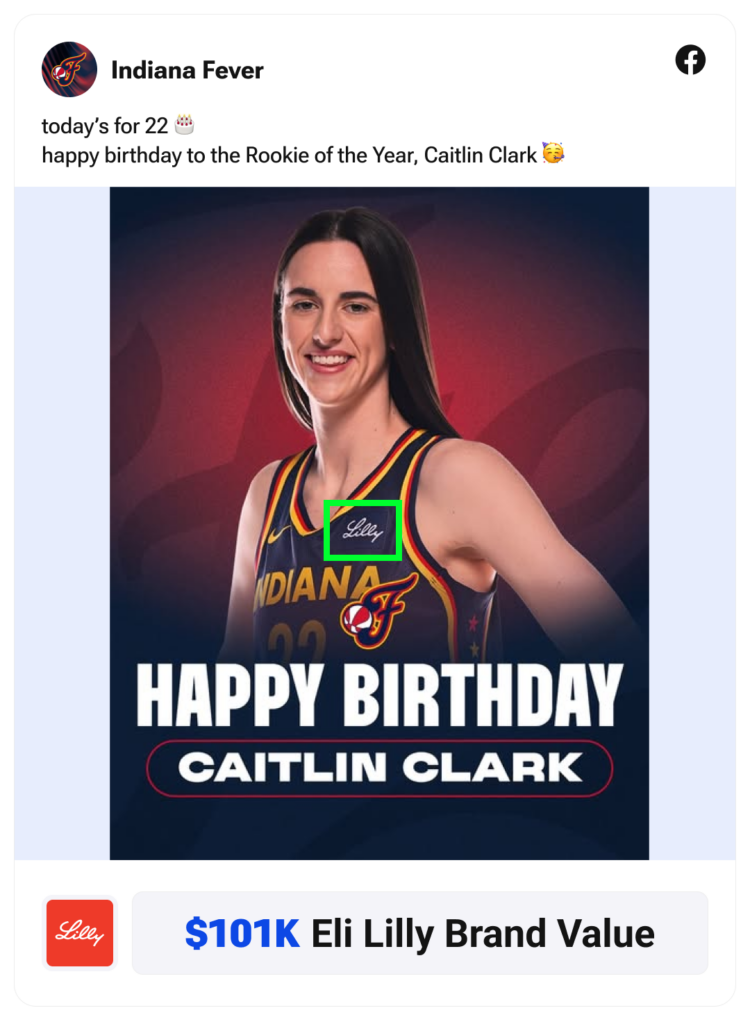
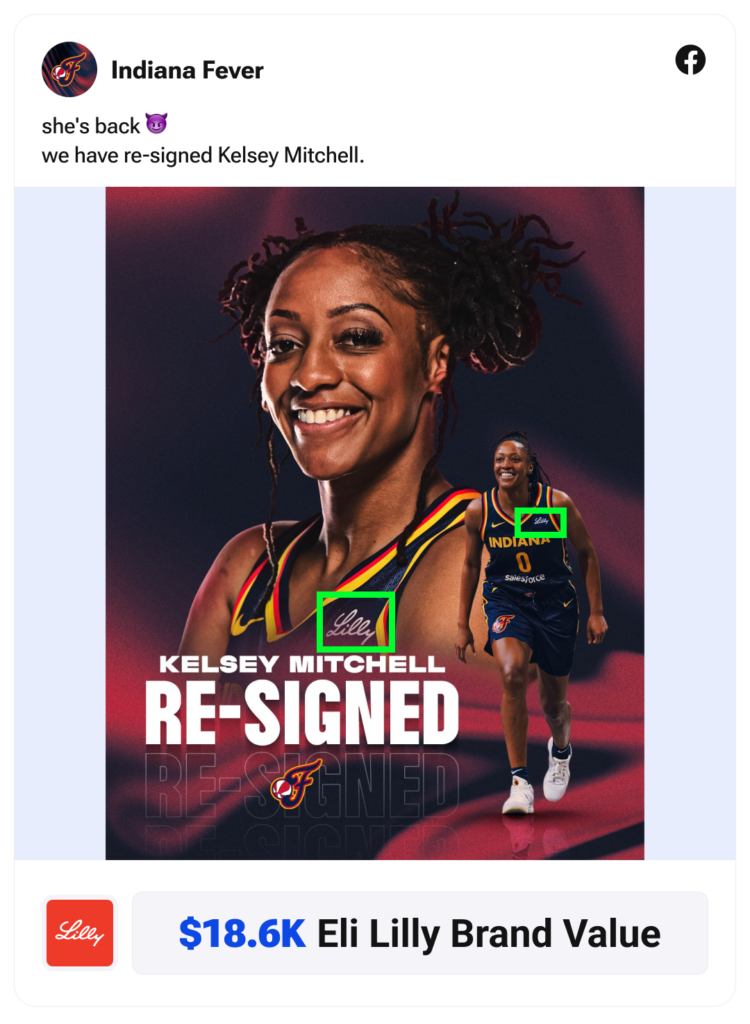
A single birthday Facebook post for Caitlin Clark generated $101,119 in brand value for Eli Lilly. An additional Facebook post announcing the re-signing of Kelsey Mitchell also generated $18,617 in brand exposure.
Neither were part of a sponsored content series, but these routine social content posts generated impressive brand exposure value because of the Fever’s account size and engagement rate.
The WNBA’s rapid growth has created a genuine sponsorship opportunity for healthcare brands across the league. Rising viewership, expanding social audiences, and deeper fan engagement mean jersey placements are delivering strong returns – and the brands that moved early are already seeing it in the data.
Orlando Health’s dual-team strategy – spanning both the NWSL’s Orlando Pride and MLS’s Orlando City SC — is a textbook example of local market ownership. By holding jersey real estate on both teams, they achieve near-unavoidable visibility for anyone consuming Orlando sports content.
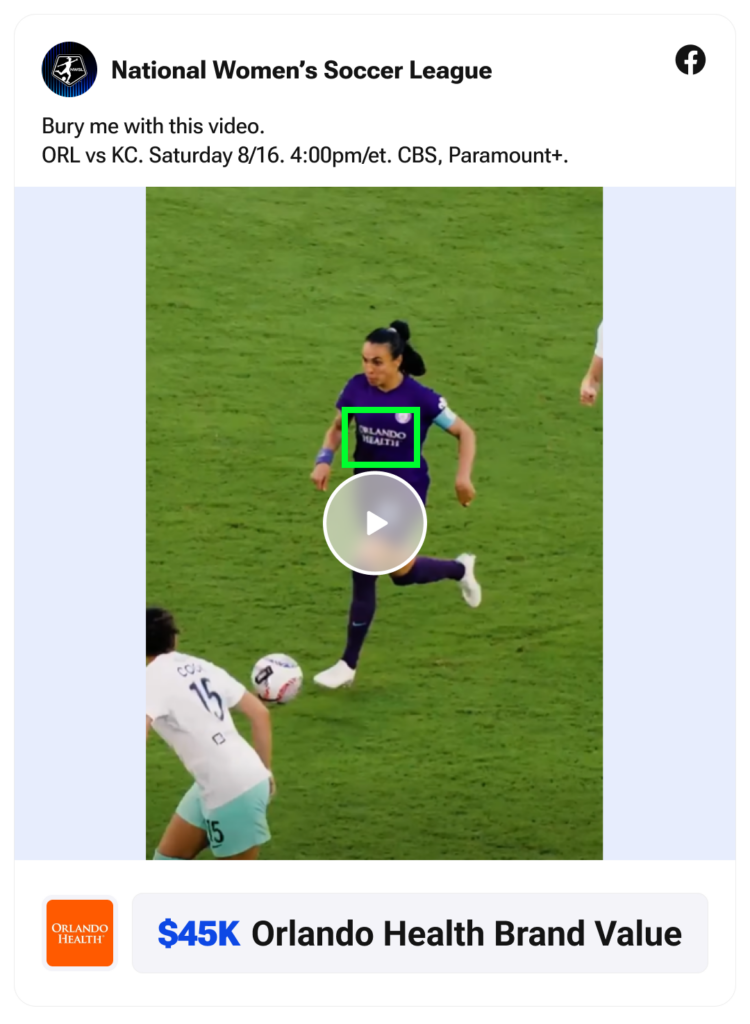
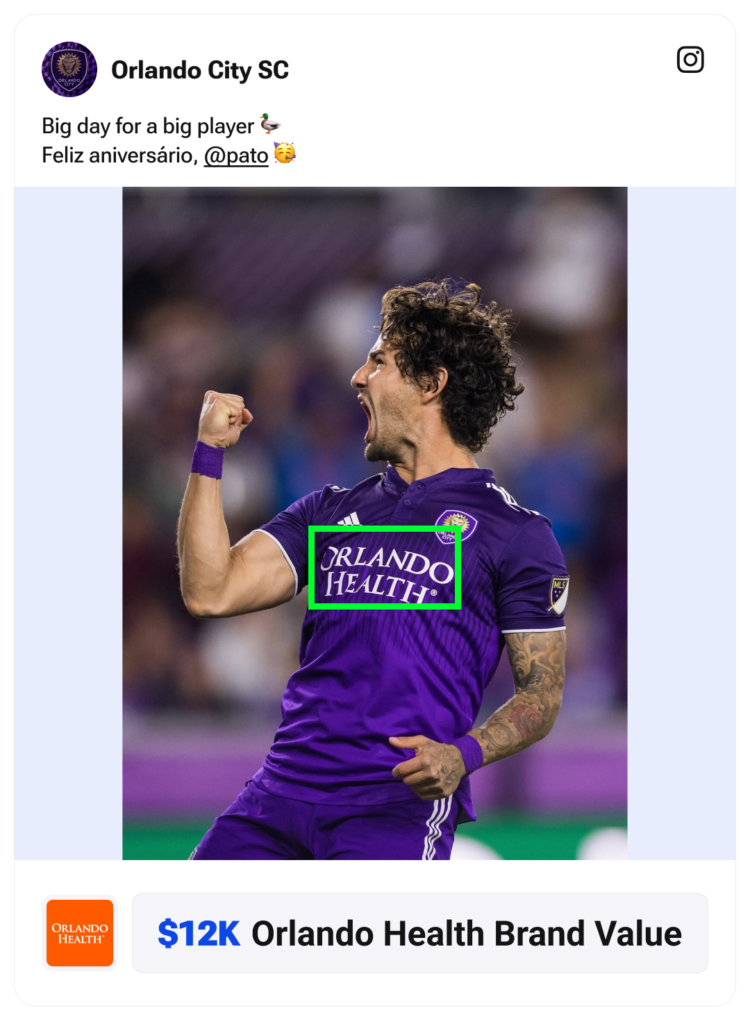
The standout result: a league-level NWSL Facebook post generated $45,483 for Orlando Health — nearly five times the value of a typical team-level post. When the league itself amplifies your sponsor content, the reach multiplier is dramatic.
This is the league amplification effect: your jersey appears not just in the partner team’s content, but in opponent content, league content, media content, and fan accounts. The sponsoring team is just the starting point.
CVS’s presence on the Washington Spirit jersey demonstrates that national healthcare brands can generate meaningful brand value through NWSL partnerships.
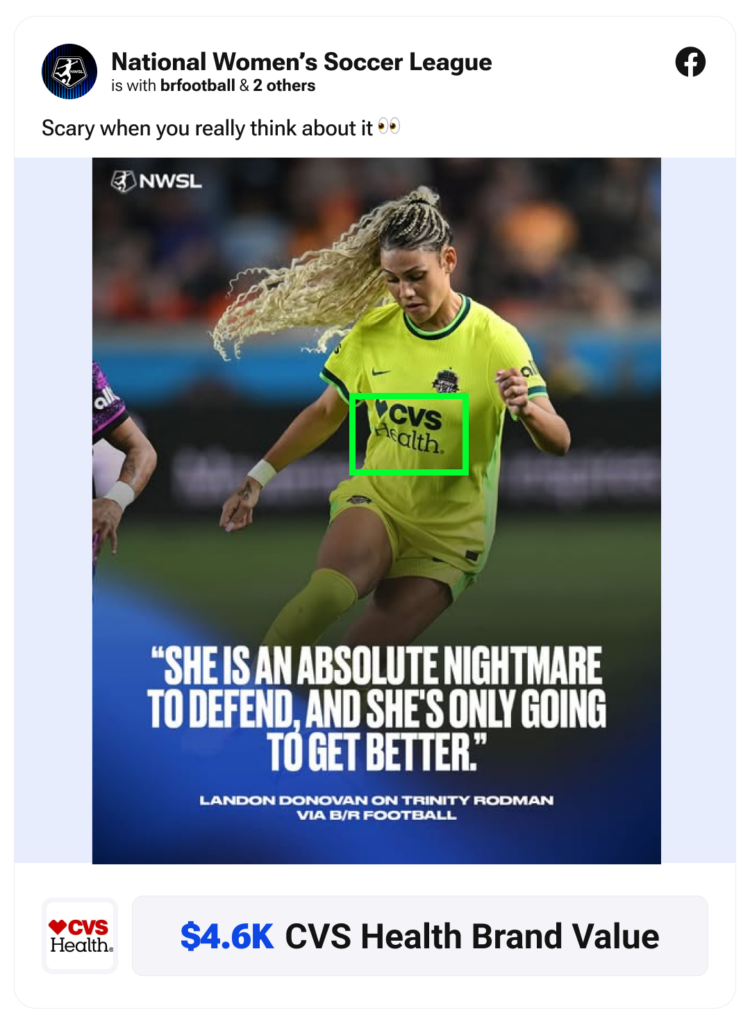
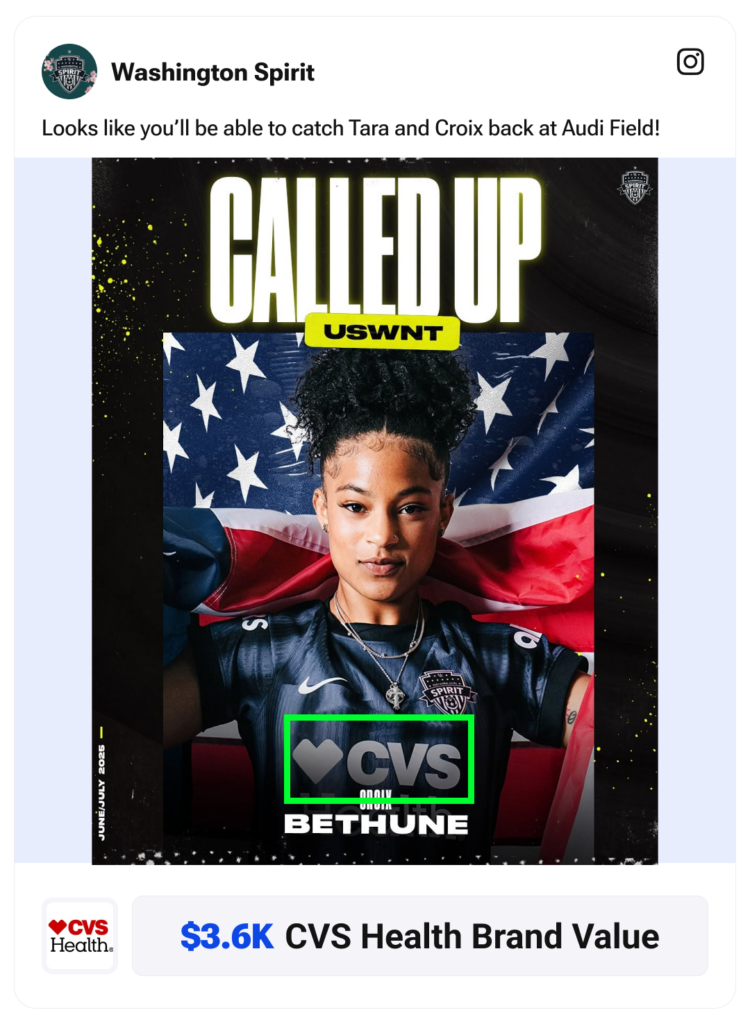
For a national brand like CVS, this isn’t purely a dollars-per-post calculation. It’s consistent brand presence alongside high-integrity women’s sports content in a key market — in a space where healthcare competitors are not yet dominant. The value of early category positioning in an emerging sponsorship space compounds over time.
League amplification plays a role in driving additional brand exposure value, but content produced by the club is also driving considerable brand exposure for CVS in a strong market.
Sponsored content is any post where the healthcare brand gets dedicated placement within the team’s own social content — score graphics, game clips, practice footage, player interview series, or milestone announcements with the brand prominently featured.
The key advantage: the team’s production quality and audience relationship does the work. Your brand rides along on content people already want to engage with.
One important data point: photos consistently outperform videos in this format. Photos give the logo 100% screen time for the entire view. Videos risk the logo appearing for only a fraction of the clip — especially in highlight-style edits where cuts are frequent.
The Warriors have one of the most engaged social audiences in the NBA and Kaiser Permanente’s sponsored activations span a number of content formats and social platforms. The Warriors also do an excellent job of showcasing the Kaiser Permanente logo in the content and including a text mention in the post copy, which helps drive additional brand exposure value.
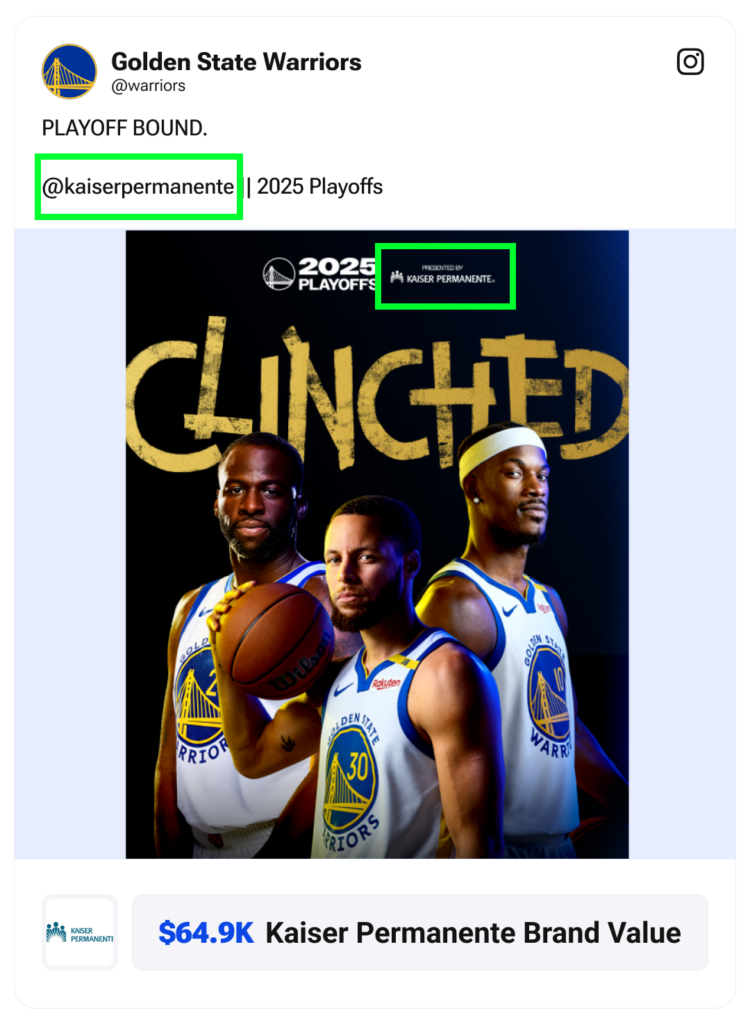
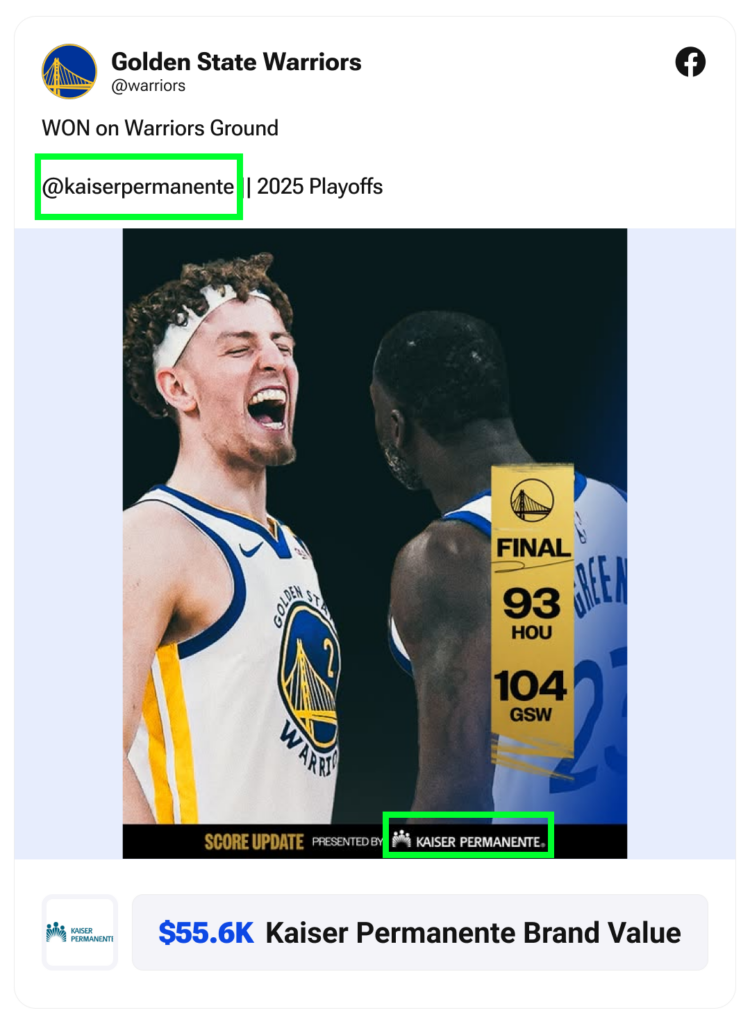
Kaiser Permanente leverages static graphic overlays attached to milestone and high affinity moments in order to generate incredibly strong sponsorship ROI. Final score graphics, while unpredictable, are a worthwhile investment because of the potential reach and volume of posts across multiple platforms.
The $64,955 Instagram post is worth examining closely: this is a team milestone post (playoff clinch), not a custom healthcare campaign activation. Aligning with high affinity moments may cost more, but the value generated is stronger than many other campaigns.
Baptist Health × Inter Miami CF
Baptist Health is a South Florida regional health system. Inter Miami is a global sports property. This partnership gives Baptist Health something regional healthcare brands almost never have access to: a content distribution footprint that extends far beyond their home market.
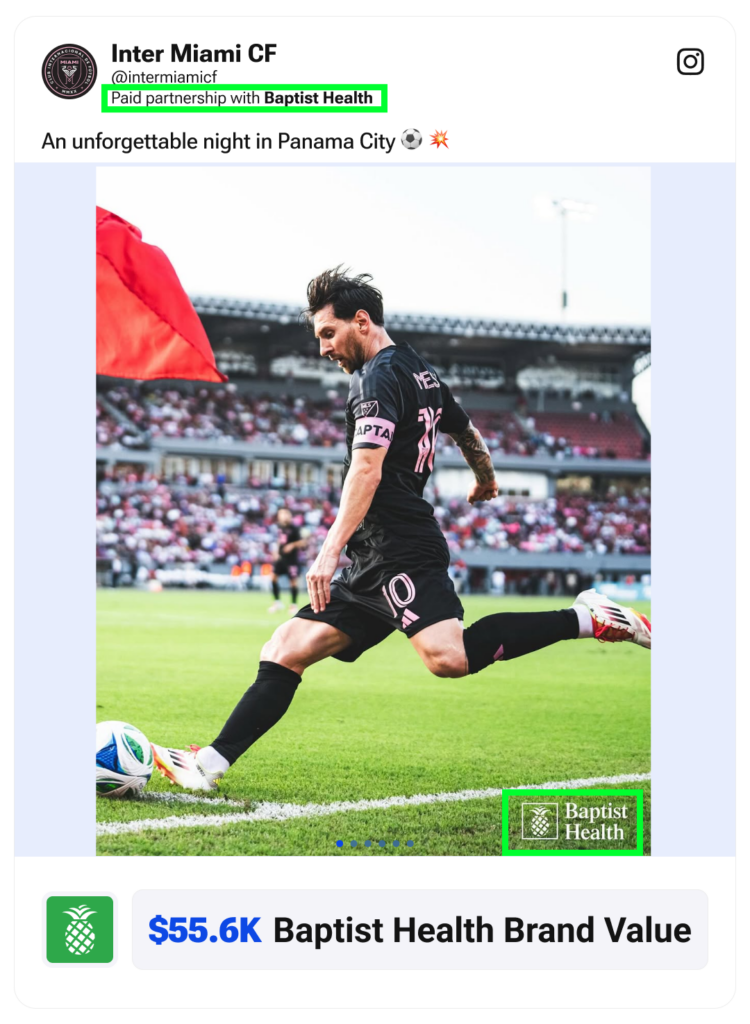
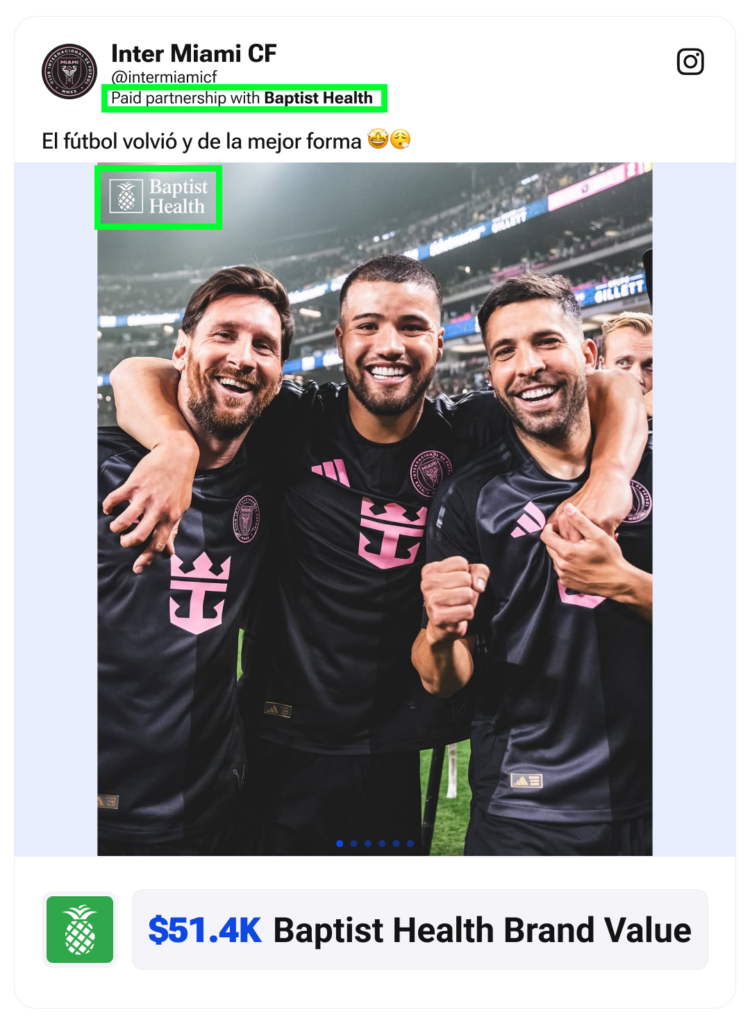
Like the Warriors, Inter Miami CF positions Baptist Health for strong brand exposure value with a static logo overlay and paid partnership tag.
That sustained cadence of these posts — rather than not a single viral spike based on a milestone — is what a strong sponsored content program looks like in practice. Consistent value across an entire season of activations matters more than any one moment.
Additionally, Zoomph analysis shows that Instagram carousel content consistently drives stronger brand exposure and media performance for sports brands.
Sideline court apron signage is the closest permanent logo to the playing surface in basketball – and that proximity is everything. It appears in wide-angle game photography, full-court highlight clips, bench moments, and player features without competing against rotating digital boards or in-game overlays.
The logos are large, the camera lingers, and nothing else is fighting for that real estate. For healthcare brands, the result is something rare in sponsorship: reliable, repeatable brand value from a single physical investment, earned across every piece of game content all season long.
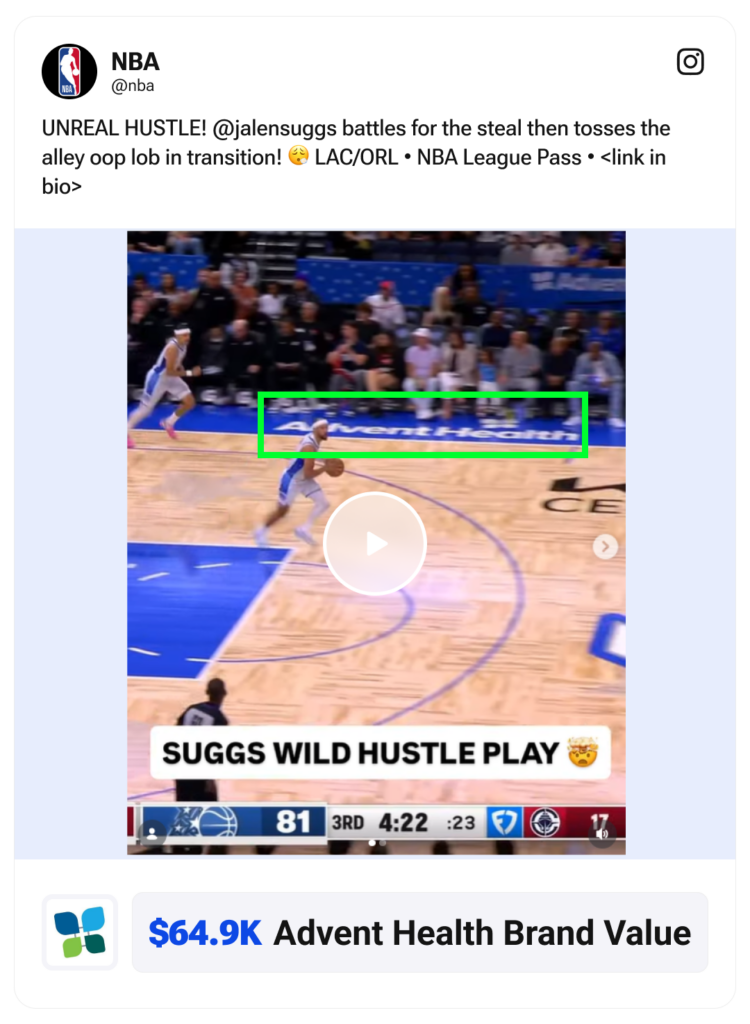
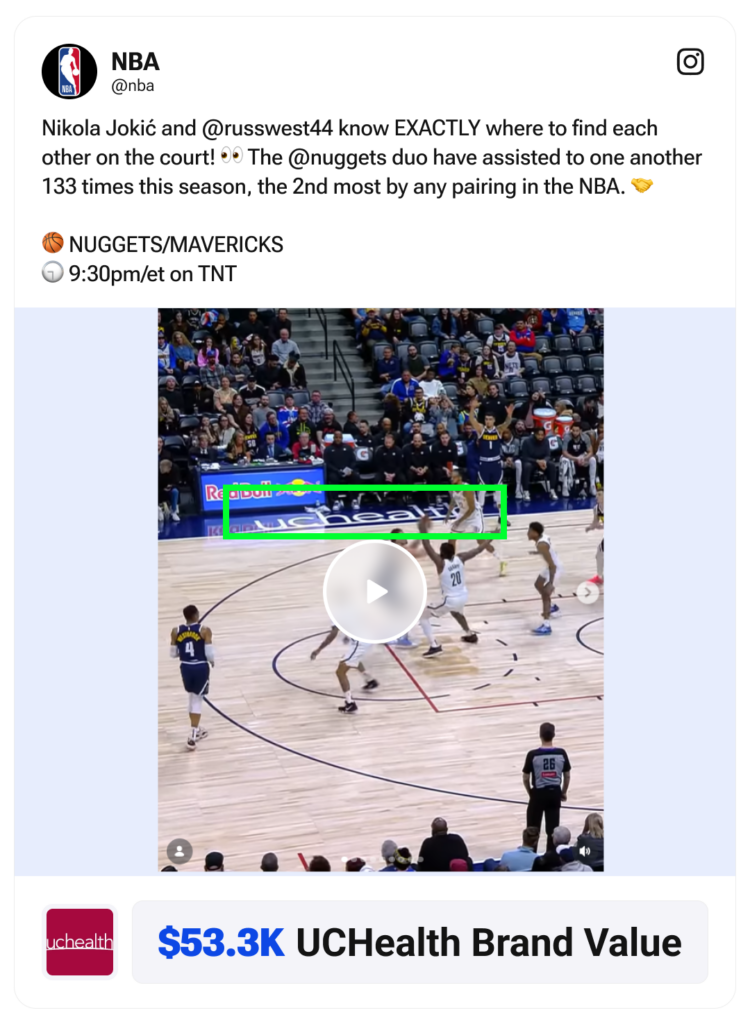
AdventHealth’s Orlando Magic partnership shows what steady, predictable court apron value looks like across a full season — with a bold, readable logo on a high-contrast background that consistently appears in NBA game highlights.
UCHealth’s partnership with the Denver Nuggets illustrates the same upside. Court apron placement ensures the logo gained visibility well beyond the Nuggets’ owned social accounts: in both cases, the NBA league account published highlight content that prominently featured the asset, reaching an audience far beyond what any single team’s following can deliver.
That’s the multiplier effect of premium court placement: one logo on the court, earning value across the entire league’s content ecosystem.
In baseball, the backstop position — directly behind home plate — gets more continuous screen time than any other signage placement in the stadium. Every pitch, every at-bat, every batter-pitcher matchup puts it in frame. That sustained visibility translates directly into brand value, and because the placement is so central to the action, it’s also the most likely stadium asset to show up in social clips shared by teams, league accounts, and media.
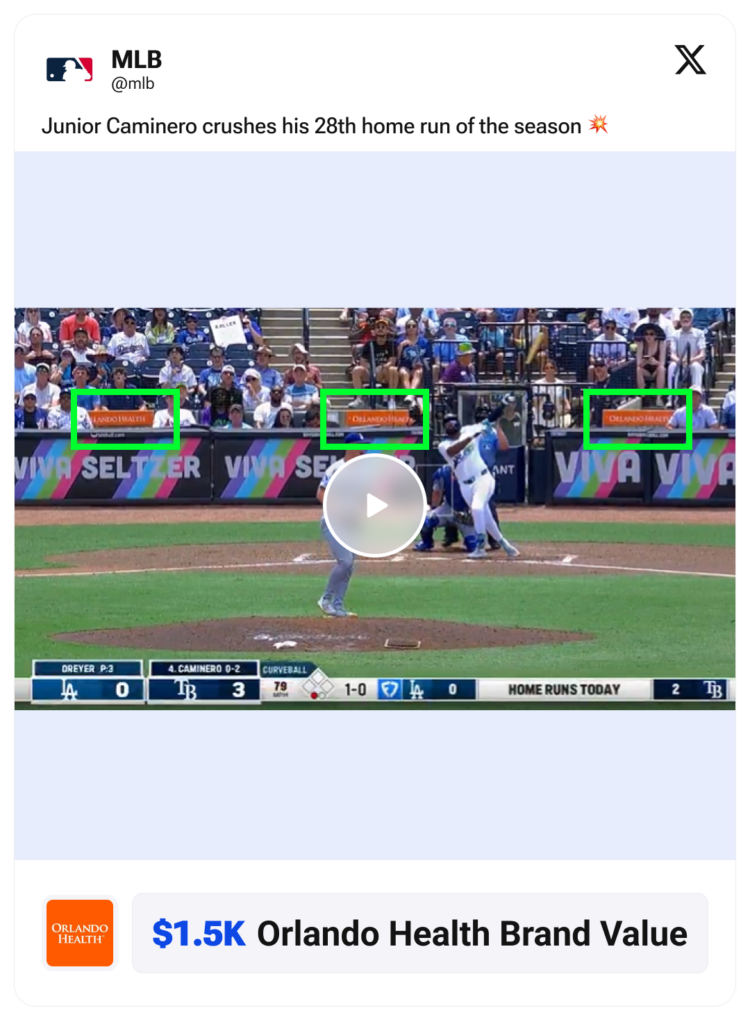
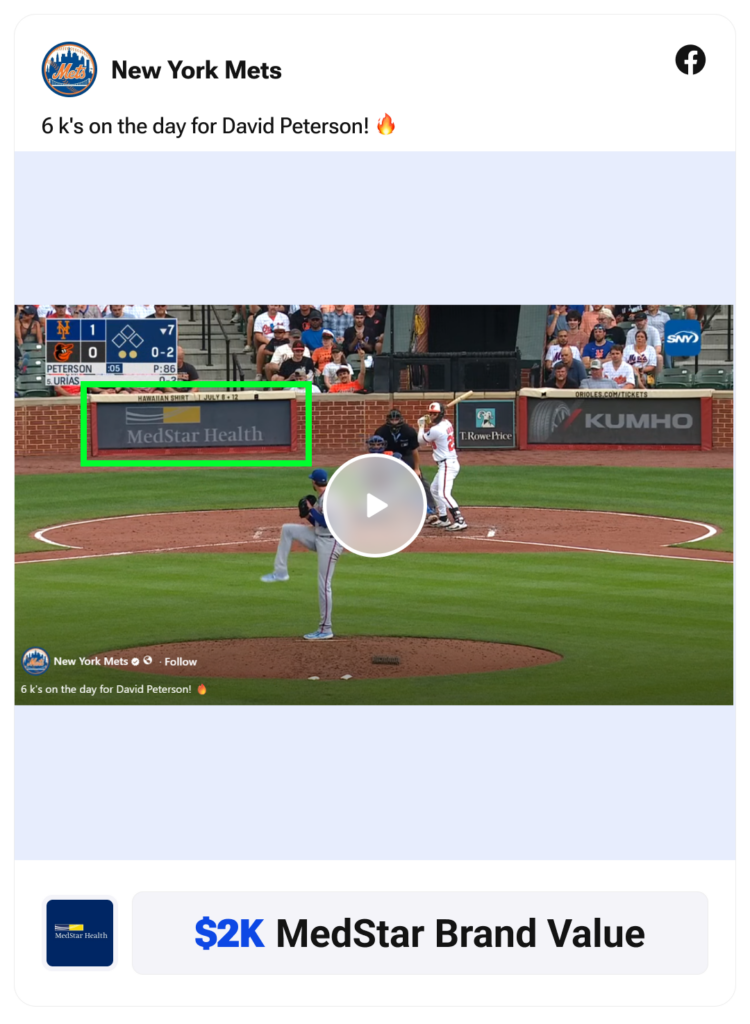
Single post values here are more modest than basketball placements — $2,069 for MedStar Health via a Mets Facebook video, $1,531 for Orlando Health via an MLB X post. But backstop value is cumulative by nature. Across a 162-game season, with content generated by teams, the league, and media on every game day, a well-placed backstop logo earns consistent exposure from opening day through the playoffs. The value is in the aggregate, not any single post.
You’re investing across multiple properties, assets, and events – jerseys, court logos, broadcast placements, sponsored content, in-venue signage. Without the right measurement infrastructure, you’re flying blind on which of those investments are actually working.
Zoomph gives healthcare brand marketers a single platform to see it all, defend it all, and act on it.
- See the full value of every sponsorship in one place. Zoomph consolidates every partner, every asset, and every activation so you can compare performance across your entire portfolio and make confident decisions about where to invest more and where to pull back.
- Capture every brand exposure — including the ones you didn’t pay for. Logo appearances in broadcast clips, viral moments, star player posts, in-venue assets — if your brand showed up, Zoomph makes sure you get credit for it.
- Get independent data you can actually defend. Your partners report their own numbers, and those numbers are inherently optimistic. Zoomph gives you consistent, third-party measurement you can bring to your CFO and your renewal conversations with confidence.
- Know which assets are working — and which ones aren’t. Jersey patch versus court logo versus sponsored content — Zoomph breaks performance down by asset so you can stop overpaying for what isn’t delivering and double down on what is.
- Benchmark yourself against the market. Zoomph shows you how other brands are activating in the healthcare sponsorship space so you know what good actually looks like — and where you have room to grow.
Sponsorship ROI is no longer a gut feel. Every impression is measurable. Every activation has a dollar value. Healthcare brands that aren’t measuring are making decisions blind.
The data in this post is just a small sample of what Zoomph tracks every day. Request a short, personalized demo to see what we’re measuring for healthcare brands like yours.